
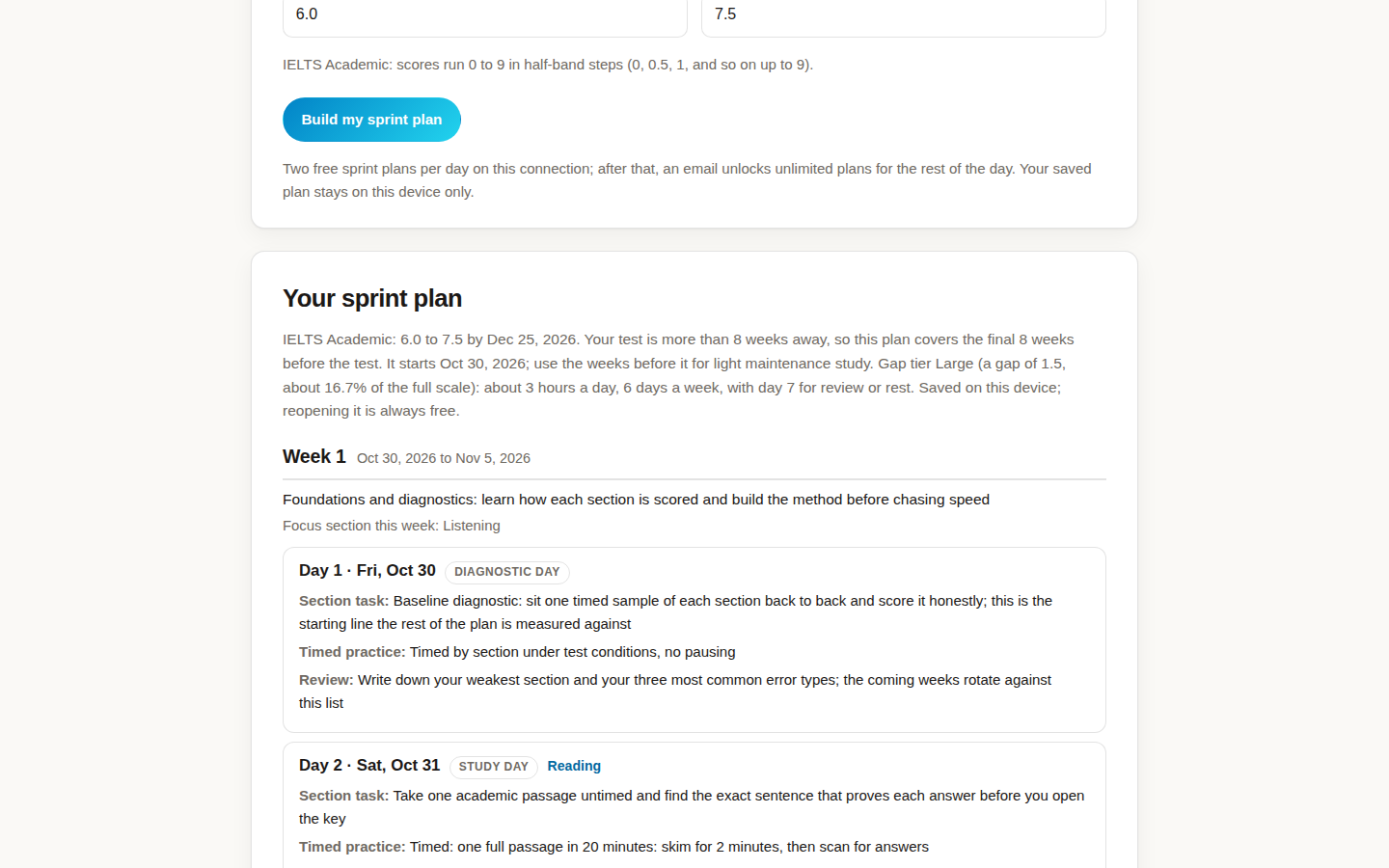
A band and a half is the gap students most often call impossible. We built a real plan in the Score Sprint Planner for exactly that profile: IELTS Academic, current score 6.0, target 7.5, test date December 25, 2026. The planner calls it a large gap, 1.5 bands is about 16.7 percent of the whole scale, and answers with about 3 hours a day, 6 days a week, across the final 8 weeks starting October 30, 2026. Six things in that plan are worth copying whatever tool you use.
1. Day 1 is a diagnostic, not a study day
Week 1 is titled "Foundations and diagnostics" and its first day is marked as a diagnostic day: one timed sample of each section, scored honestly, then a written list of your weakest section and your three most common error types. Every later week rotates against that list. Skipping the diagnostic is how students spend 8 weeks improving at what they were already fine at.
2. Each week has one focus section
The plan names a focus section per week, Listening in week 1, and the daily tasks follow it: day 2 moves to Reading with an untimed passage where you find the exact sentence that proves each answer before opening the key, then the same passage timed. Depth on one section at a time beats a shallow lap of all four every day.
3. Day 7 is review or rest, and it is in the plan
Six study days, not seven. The planner builds the rest day in from the start, which is what makes 3 hours a day survivable for 8 weeks. Students who plan 7 days usually deliver 4; this plan asks for 6 and means it.
4. The last weeks belong to full mocks
The arc bends from drills to complete timed papers under test conditions. By then the question is no longer whether you know the techniques; it is whether they survive 2 hours and 45 minutes of clock. That is also when a target check matters: our IELTS 6.5 universities guide shows how many programs a smaller jump already unlocks.
5. A distant test date does not mean starting the sprint now
Because the test sat more than 8 weeks out, the plan starts October 30 and says so: the earlier weeks are for light maintenance. Burning sprint intensity for 12 weeks is how candidates peak in week 9 and sit the test in week 12.
6. Shrink the gap before you schedule against it
The hours scale with the gap: a small gap needs about an hour a day, not three. So check the requirement first, in our TOEFL requirements comparison if TOEFL is your test, and check whether you need the test at all in the waiver universities guide. Official formats and scoring sit with ETS for TOEFL. Once the target is real, the funding search runs in parallel: ScholarshipMatch at StudyAbroadExperts checks your profile against 494 scholarships. Build the plan you will actually follow: plan your 8 weeks.